A Timeline of Baltimore Hockey
Beginnings
(1894) |
![]() |
Records in the US Hockey Hall of Fame indicate that Baltimore is credited with building the first indoor arena in North America with artificial ice, and held what was possibly the earliest organized hockey game. In 1894, a game was played at the opening of the North Avenue Rink between the John Hopkins University and the Baltimore Athletic Club.
Baltimore Orioles
(1932-1942) |
 |
The city's inaugural professional hockey team was known as the Baltimore Orioles (a popular choice!), and played in the Tri-State Hockey League from 1932-1933 and the Eastern Amateur Hockey League from 1933-1942 until they were disbanded because of World War II. The Orioles were coached by Billy Boyd (1933–35), Gord Fraser (1935–36), Bill Hines (1938–41), and Elmer Piper (1941–42). The team won the EAHL championship in the 1939–40 season. Notable league executive Jack Riley played for the Orioles from 1938 to 1942. Twelve Orioles also played in the National Hockey League.
US Coast Guard Yard Teams
(1941-1944) |
  |
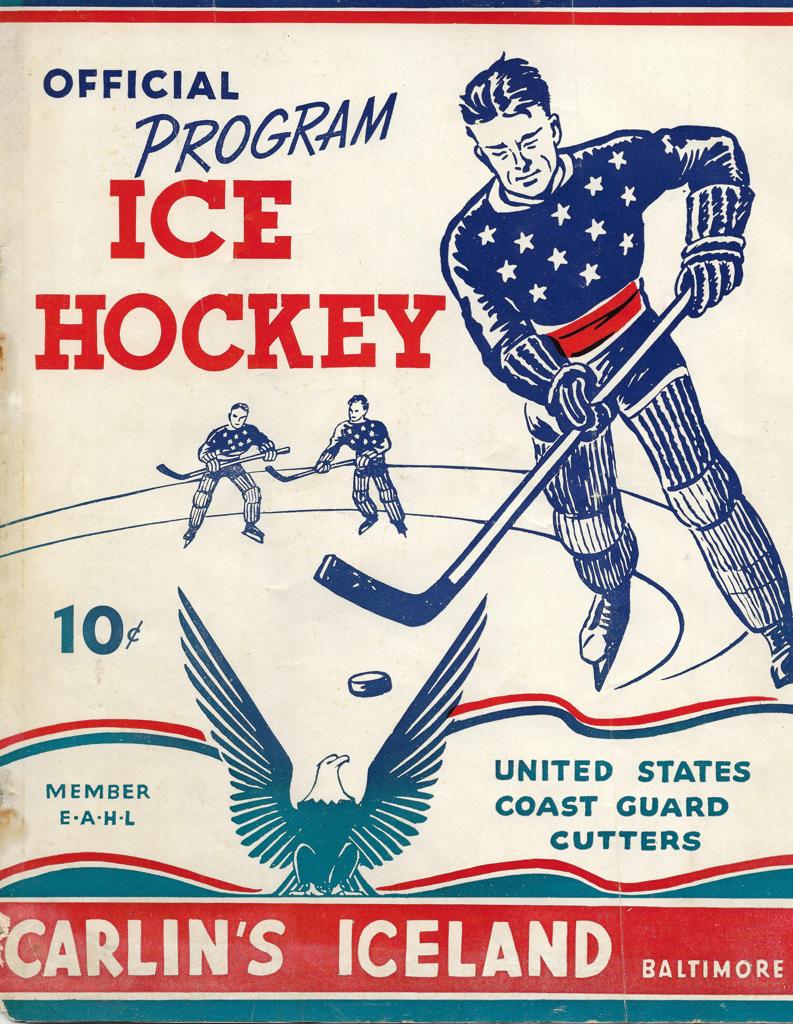
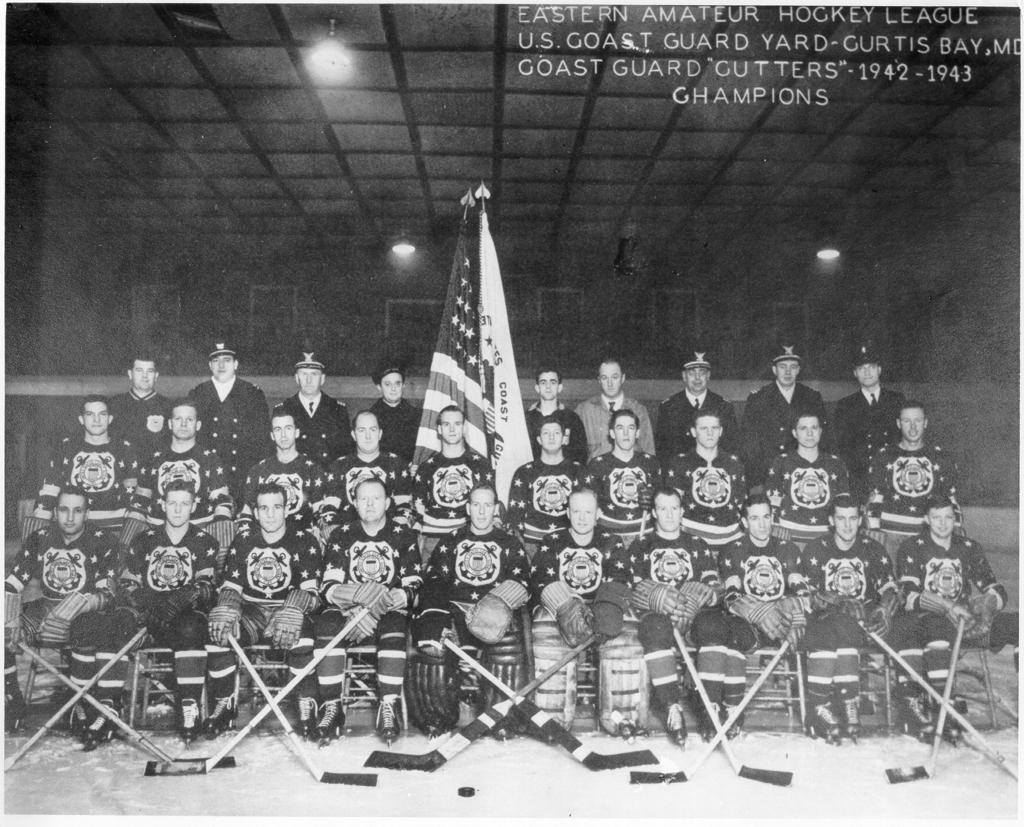
The United States Coast Guard Yard in Curtis Bay, MD fielded two hockey teams in the early 1940s. The first was the US Coast Guard Yard Bears, an independent team of service members that briefly played from 1941 to 1942. In 1942, Lieutenant Commander C.R. MacLean founded the US Coast Guard Cutters, a senior amateur team that played in the Eastern Amateur Hockey League for parts of two seasons, using Carlin's Iceland for home games. They were coached by Mel Harwood, a former goaltender for the Orioles, and a former NHL referee known for officiating game four of the 1942 Stanley Cup Finals. Players were required to complete daytime military duties, in addition to playing on the team. The team was accompanied by their own version of the United States Coast Guard Band that played the “Semper Paratus march," whenever the Cutters scored a goal.
In the 1942–43 season, Joe Kucler led the league in goals (40), assists (41), and points (81). The Cutters played the defending Stanley Cup champion Detroit Red Wings in an exhibition game on January 6, 1943 in Baltimore, losing 8–3. The Cutters finished first place in the EAHL, winning the Walker Cup. In addition to the EAHL title, the Cutters won two championships of the Amateur Hockey Association of the United States, in 1943 and 1944. Eleven games into the second season, the Cutters withdrew from league play on November 28, 1943, but still played exhibition games. The Cutters team disbanded early in 1944, when the World War II effort needed reinforcements.
Baltimore Blades/Clippers
(1945-1949) |
 |
The Baltimore Clippers were a minor league professional ice hockey team from in Baltimore, Maryland, playing in the Eastern Amateur Hockey League at Carlin's Iceland. The team began play in the 1944–45 season known as the Baltimore Blades, and were renamed the Clippers from 1946 to 1949. The team name paid homage to local history in the Baltimore Clipper, and the Port of Baltimore. The Clippers ceased operations during the 1949–50 season.
Baltimore Clippers
(1954-1956) |
 |
The Baltimore Clippers began play in the Eastern Hockey League during the 1954–55 season, with Andy Brown as coach. Herve Lalonde led the team, scoring 22 goals, and 50 assists, winning the John Carlin Trophy, as the league's top scorer. In the playoffs, Baltimore defeated the Clinton Comets 3 games to 1 in the first round, but lost the finals in four straight games to the Washington Lions. On January 23, 1956, midway through the Clippers' second season, their home arena, Carlin's Iceland, burned down. The team found a temporary home in Charlotte, and buoyed by strong attendance numbers, elected to remain there...ultimately becoming the Charlotte Checkers (1956-1977).
Baltimore Clippers
(1962-1977) |
 |
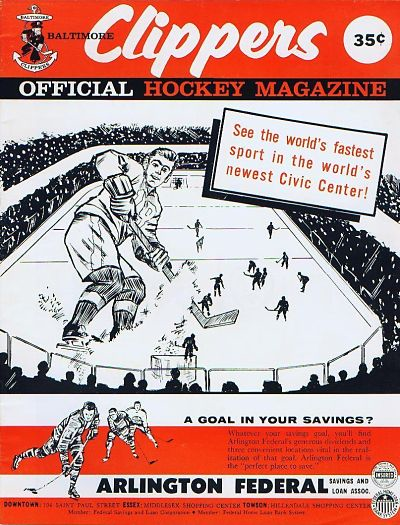
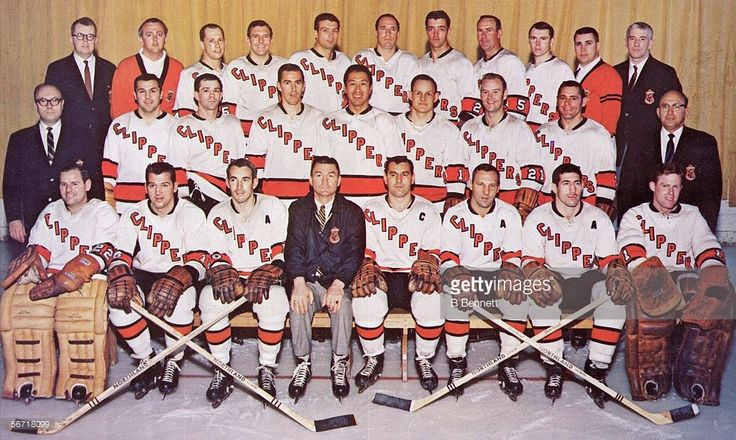
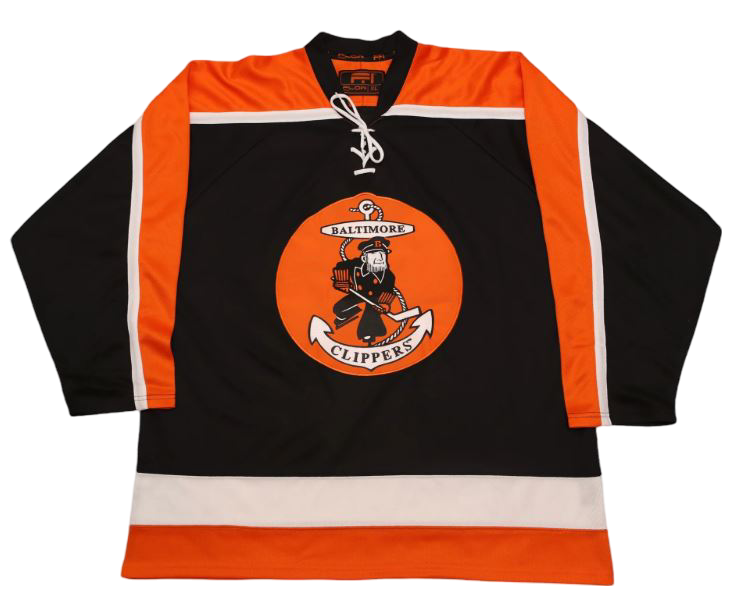
The Baltimore Clippers were a minor league professional ice hockey team from in Baltimore, Maryland, playing in the Baltimore Civic Center. The Clippers were members of the American Hockey League from 1962 to 1976, and then played one season in the Southern Hockey League. The team was managed by Terry Reardon for its first fourteen seasons, and won three division titles, but were unable to capture a Calder Cup title. Baltimore began as a farm team for the New York Rangers, and helped develop Hall of Fame players including, Eddie Giacomin, Doug Harvey, Jacques Plante and Jean Ratelle. The Clippers also featured eight alumni, who are now members of the AHL Hall of Fame. The team name "Clippers", was used by two previous professional hockey teams in Baltimore, and paid homage to local history in the Baltimore Clipper, and the Port of Baltimore.
Baltimore Blades
(1974-1975) |
 |
In 1974 the Michigan Stags of the World Hockey Association (WHA) relocated to Baltimore and became the Baltimore Blades.the move caused the American Hockey League's Baltimore Clippers, already in financial trouble, to promptly fold. After playing seven straight road games (all losses), the Blades debuted at the Baltimore Civic Center on February 2 (coincidentally against the Howe-led club from Houston) in front of 9,023 fans. Attendance went flat soon thereafter, however, as the Blades averaged only 3,568 for 17 home dates (which was actually an improvement over Detroit, even though the Blades were an awful 3-13-1 in Baltimore.) At season's end, the league contemplated moving the franchise to Seattle (which would have marked the franchise's fourth home in less than a year), but instead the club was terminated. Players from the Michigan/Baltimore team, along with those of the defunct Chicago Cougars, were put into a dispersal draft to be claimed by other WHA teams.
The team's final record was 21-53-4, the second-worst in the WHA and far out of a playoff spot. Veneruzzo was the leading scorer for the team with a 33-27-60 mark, nearly twice as much as anyone else save for Jean-Paul LeBlanc. (The infamous enforcer Bill Goldthorpe also signed on for seven games, piling up 26 penalty minutes.) The last active Stags/Blades player in major professional hockey was Ed Johnstone, who last played in the 1986-87 NHL season.
Washington Capitals
(1974-Present) |
 |
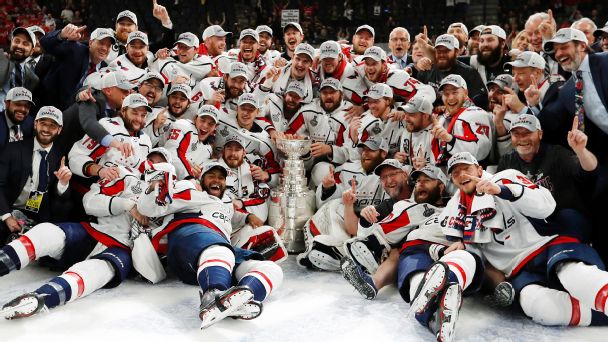
I'd be remiss not to list the Capitals here, as these days they're the only local option for professional ice hockey in the vicinity of Baltimore. The Caps were founded in 1974 as an expansion team, initially struggling to compete in the NHL. In 1982, David Poile was hired as general manager, helping to turn the team's fortunes around. With a core of players such as Mike Gartner, Rod Langway, Larry Murphy, and Scott Stevens, they became a regular playoff contender for the next fourteen seasons. After purchasing the team in 1999, Leonsis revitalized the franchise by drafting star players such as Alexander Ovechkin, Nicklas Backstrom, John Carlson, Braden Holtby, Evgeny Kuznetsov and Tom Wilson. In the 2009–10 season, the Capitals won the franchise's first Presidents' Trophy for being the team with the most points at the end of the regular season. They won it a second time in 2015–16, and for a third time the following season in 2016–17. In addition to 13 division titles and three Presidents' Trophies, the Capitals have reached the Stanley Cup Finals in 1998 and 2018, winning the latter in five games against the Vegas Golden Knights.
The Capitals have retired the use of four numbers in honor of four players. In addition, the team holds an association with a number of individuals inducted into the Hockey Hall of Fame. The Capitals are affiliated with two minor league teams: the Hershey Bears of the American Hockey League and the South Carolina Stingrays of the ECHL.
Baltimore Skipjacks
(1979-1993) |
 |
The Skipjacks originated in 1979, and played as the Baltimore Clippers in the Eastern Hockey League for two seasons. The team was renamed to Skipjacks in 1981, and played the following season in the Atlantic Coast Hockey League. The Skipjacks then played eleven seasons as members of the American Hockey League (AHL), from 1982 until 1993. The Skipjacks were one of three AHL teams to have been based in Baltimore, including the Baltimore Clippers, and the Baltimore Bandits. The Skipjacks operated as a farm team to the Pittsburgh Penguins and Washington Capitals for five seasons each, and were previously a farm team to the Minnesota North Stars for two seasons, the Boston Bruins for one season. The team played its home games at the Baltimore Civic Center, which was renamed to the Baltimore Arena in 1986.
Gene Ubriaco was the team's head coach for seven seasons, and won the AHL Coach of the Year Award during the 1983–84 AHL season, when he led the Skipjacks to a division title. The Skipjacks reached the Calder Cup finals in the 1984–85 AHL season, but were defeated by the Sherbrooke Canadiens. In the same season, Jon Casey won the AHL Goaltender of the Year Award and led the AHL in goals against average. Mitch Lamoureux is the Skipjacks career leader in goals (119), assists (133), and points (252), and was inducted into the AHL Hall of Fame.
In 1993, the Skipjacks relocated to Portland, ME and became the Portland Pirates (1993-2016).
Baltimore Bandits
(1995-1997) |
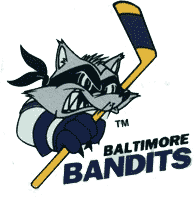 |
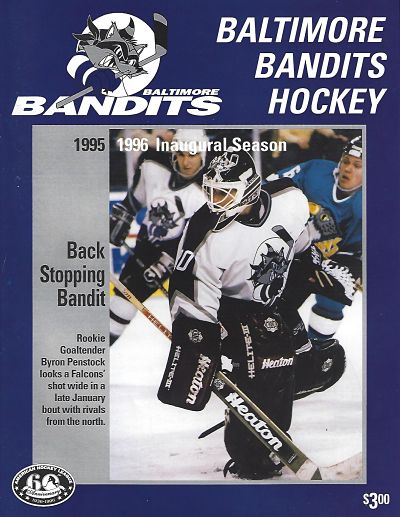
The Baltimore Bandits were an ice hockey team in the American Hockey League in the 1995–96 and 1996–97 seasons. The team wwas an affiliate of the National Hockey League's Mighty Ducks of Anaheim, and played their games at the Baltimore Arena. The Bandits logo was a stylized raccoon developed by Disney Sports Enterprises. It was intended to resemble the Disney character 'Meeko the Raccoon' from Pocohontas. After two years of minimal on-ice success, the franchise was moved to Cincinnati and became the Cincinnati Mighty Ducks.
The Future???
(????-????) |
![]() |
Will professional hockey return to Baltimore???
|
Baltimore Rinks
North Avenue Ice Palace (1894-1900)
Carlin's Iceland (1931-1956)
Baltimore Civic Center (1962-Present)
Columbia Ice Rink (1970-Present)
|

Sources / Contact